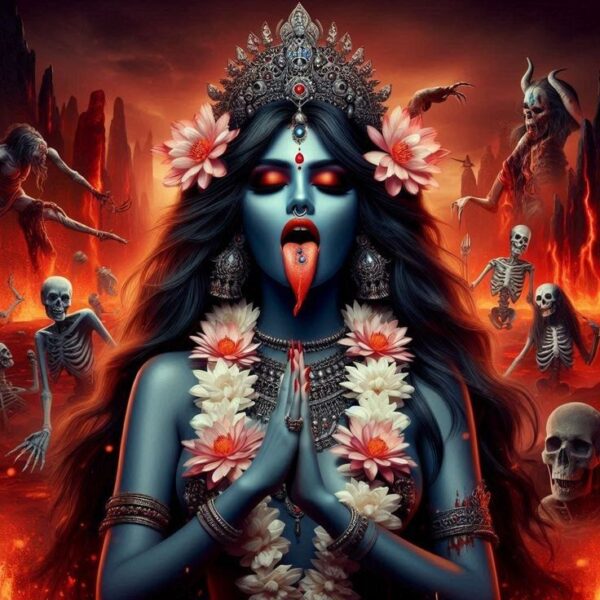
Kali: Great Mother Goddess.
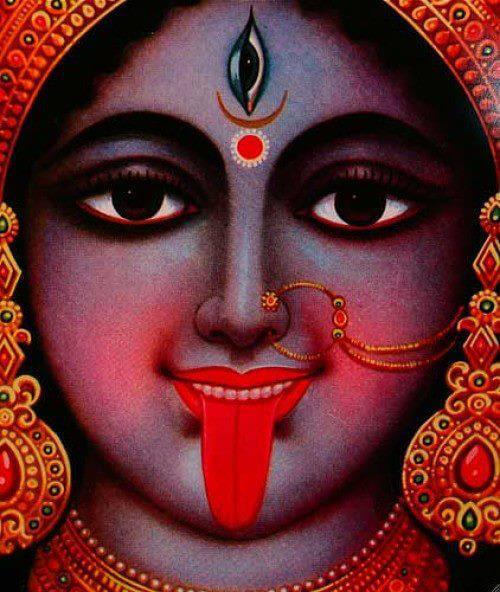
“Only Kali should be worshiped in the Kali-yuga ….”
Shakta-pramoda.
Tantrism is, first, Shaktism.
And Shaktism is inconceivable without reverence for Shakti Devi, the Great Divine Mother. Among the countless revered forms and images of the Goddess, a special place belongs to the mysterious, at the same time alluring and frightening, always exciting the soul and leaving no one indifferent to the formidable Goddess Kali.
The scriptures of Hinduism and Tantra are full of praise for Kali, and in the left-hand tantra tradition Kali is the main and central object of worship.
In the kulachara, the most esoteric of all the tantric “left hand” acharas, the tantrik fully comprehends his mystical unity with Kali, and through Her grace – with Shiva Himself. Therefore, devotion to Mother Kali naturally arises in those people whose souls are already fully ripe for the practice of kulachara.
“As a result of the good merits accumulated during many reincarnations, the practice of asceticism, donations and strict vows, the consciousness of the sadhaka, who has renounced all sins, tends to the kulachara.
The mind of one who is immersed in the practice of kulachara is quickly purified. Then spontaneous devotion to the lotus feet of the Primordial Kali arises,” says the Mahanirvana Tantra (7.99-100).
The fact that the practice of kulachara leads to a state of oneness with Kali is confirmed by the following words of the Kali-tantra: “In the sadhaks who have attained the true knowledge of Kula, the presence of Kalika is manifested.”
The name Kali is derived from the Sanskrit word kala, meaning black.
This has a deep esoteric meaning. Just as the black color absorbs all other colors, Kali absorbs and contains in Itself all conceivable forms and manifestations of God – from the most merciful and benign to the most angry and terrifying.
People with a superficial perception of the Divine Reality are usually attached only to the sugary-blissful forms of the Divine. Such people can be compared with enthusiastic sun worshipers, jubilant in the light of day, when nothing is visible that could compare with the sun as a source of life and light. But with the onset of night, everyone is convinced that against the background of the boundless blackening sky there are an innumerable number of such “suns”.
Also, all forms of God revered by different religions are only dimly twinkling “stars”, partial manifestations of the strength and energy of the infinitely powerful Kali. It is in Her that the Divine Reality can be revered in all its immense fullness.
Therefore, of all the forms of the Mother Goddess, it is Kali that personifies the Primordial Shakti (Adya Shakti), from which all other divine forms, both female and male, are derived, for, in the words of the Gandharva Tantra, “the male form, the female form , any form in general – all forms, undoubtedly, are manifestations of Her Highest Form ”.
In the tenth chapter of the Nirvana Tantra it is said that, just as a tree grows and sinks deeper into the earth, a bubble – into the water column, or luminaries – into clouds, so all the gods have their beginning and end in Kali.
According to the Mahanirvana Tantra (4.30-32), Time (Kala) devours the whole world during cosmic dissolution (pralaya), but Kali devours even Time itself, therefore She is called the word Kali. Kali is Adya-Shakti, the Primordial Divine Power, inseparable from His Spouse, Parama-Shiva, i.e. Brahman (Absolute).
According to the Devibhagavata Purana and other Sakta scriptures, in the course of cosmic manifestation, the Primordial Shakti manifests Himself as partial forms (amsa-rupa), even smaller forms (kala-rupa) and as forms that are parts of parts (kalamsa-rupa).
The manifestations of the first type include Dakshinakali, Durga, Lakshmi, Saraswati, Savitri, Radha, Bhairavi and other revered spiritual forms of Devi, the manifestations of the second type are the younger female deities (Ganga, Tulasi, Manasa, Shashthi and others), and the manifestations of the third type are all local revered forms of the Goddess (the so-called grama-devats, embodied in temple shrines), other minor deities and, finally, all female beings in general.
Although the Divine Mother is one and there is nothing outside Her (except for Parama-Shiva, from whom Shakti is always inseparable), for the needs of those who worship Her and in the course of Her divine pastimes (lilas) She takes all kinds of countless forms. Thus, the Mahakala-samhita mentions nine manifestations of the Goddess Kali:
Dakshinakali, Shmashanakali, Bhadrakali, Guhyakali, Kalakali, Kamakalakali, Dhanakali, Siddhakali and Chandikakali.
Other Tantras describe a different number of forms of Kali, depending on what functions certain manifestations of the Mother perform and what they symbolize. Acharya Abhinavagupta of Kashmir lists twelve manifestations of Kali in his Krama-stotra. But in whatever forms Kali appears, She does not cease to be the One Power that is sung by “Devi Mahatmya”:
MAHAVIDYA MAHAMAYA MAHAMEDHA MAHASMRITIH
MAHAMOHA CHA BHAVATI MAHADEVI MAHASURI
Great Knowledge, Great Illusion, Great Wisdom and Great Memory,
Great Delusion and All the mistress, the Great Goddess and the Great Demoness!
Goddess Mahakali spiritual Courses, Empowerments/Attunements
Discover more from Sundari Magic | Spiritual Initiations, Energy Empowerments & Mystical Practices
Subscribe to get the latest posts sent to your email.