Goddess Kali
The Sanskrit word “kala” means both “death” and “time.”
According to the Mahanirvana Tantra, “time, or kala, devours the entire world during cosmic dissolution – pralaya, but Kali devours even time itself, which is why she is called by the name Kali.” Goddess Kali is the supreme goddess, the night of eternity, and the devourer of time.
Her Appearance:
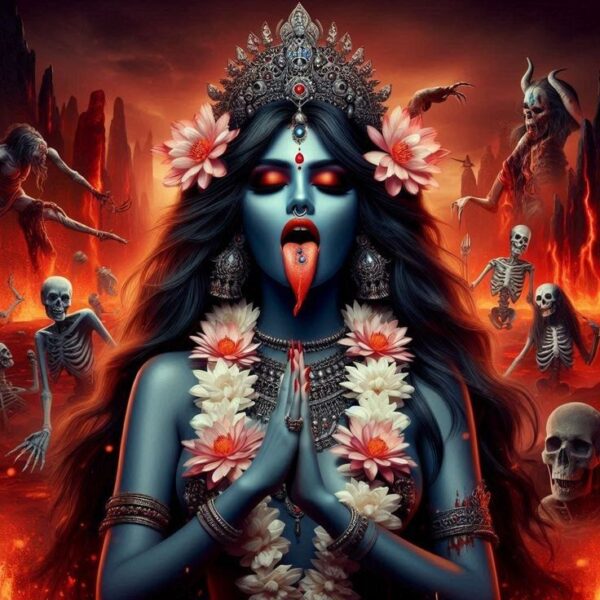
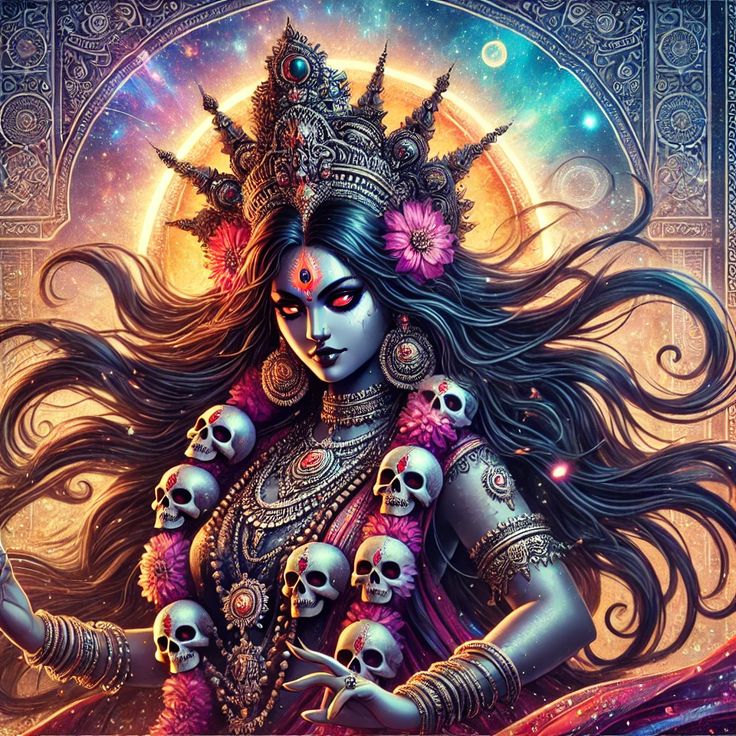
“Her form is terrifying. Her hair is disheveled, and she wears a garland of freshly severed human heads. She has four arms. In her upper left hand, she holds a sword, freshly stained with the blood of a severed head that she carries in her lower left hand. Her upper right hand is raised in a gesture of fearlessness, while her lower right hand grants blessings. Her complexion is dark, resembling a storm cloud.
She is completely naked, her body glistening with blood flowing from the garland of severed heads around her neck. Her earrings are made of corpses. Her fangs are monstrous, and her face expresses rage. Her breasts are full and round, and she wears a belt of severed human hands. Blood drips from the corners of her mouth, enhancing the brilliance of her face.
She emits piercing cries and resides in cremation grounds, surrounded by howling jackals. She stands atop Shiva, who lies in the form of a corpse. She seeks sexual union with Mahakala in a reversed position. Her facial expression is satisfied, and she smiles. She radiates like a dark cloud and wears black robes.”
Kali is the only goddess who fully reveals the nature of supreme reality and symbolizes perfectly enlightened consciousness. The principle of destruction embodied in Kali aims to dispel ignorance and illusion.
Symbol of Female Autonomy:
Kali is also a symbol of female self-sufficiency and emotional independence. The Kali Tantra emphasizes that even in sexual relations, Kali assumes the dominant position, taking on the traditionally male role. Kali possesses immense sexual energy. In later texts, especially in the Tantras, she is depicted as sexually aggressive and is often portrayed in union with Shiva. In her Sahasranama Stotra (hymn of a thousand names), many names highlight her sexual insatiability or allure.
Among her names:
She whose essential form is sexual desire
She whose form is the yoni (female sexual organ)
She who resides in the yoni
Adorned with a garland of yonis
She who loves the lingam (male sexual organ)
Residing in the lingam
She who is worshipped with semen
Dwelling in the ocean of semen
Always filled with semen
In this context, Kali defies the notion of a controlled woman satisfied by marriage. Kali’s sexual appetite makes her dangerous.
Freedom Beyond Social Norms:
Kali embodies freedom, particularly freedom from societal norms. She lives beyond the boundaries of conventional society, preferring cremation grounds, places shunned by the ordinary. She resides in forests or jungles among wild beings. Her unbound hair and nudity signify her complete independence from social and ethical obligations and expectations. For this reason, she is an outsider, living beyond societal conventions.
Two typical features of Kali’s appearance—her unbound hair and protruding tongue—symbolize her “otherness,” her nonconformity, and her boundary-breaking, transformative nature. In iconography, she is almost always depicted with an open mouth and a protruding tongue. In her early depictions, as a wild, bloodthirsty goddess on the edges of civilization or as a fierce demon-slayer drunk on the blood of her victims, her protruding tongue conveys her thirst for blood.
The Protruding Tongue in Tantra:
The protruding tongue of Kali holds two primary meanings in the context of Tantra: sexual satisfaction and the consumption of the forbidden or impure. In depictions of Dakshina Kali, Shiva is sometimes shown in a state of arousal, and in some dhyana mantras and iconographic images of Kali, she is depicted in sexual union with him. In both cases, her tongue is shown sticking out.
Kali’s open mouth and protruding tongue, her appearance and habits, are repulsive to our ordinary sensibilities. Perhaps this is central to Tantra. What we perceive as repugnant, impure, forbidden, or grotesque stems from limited human or cultural consciousness that categorizes reality according to narrow, self-serving concepts of what the world should be. Kali disrupts these categories with her rawness, inviting her devotees to be open to the world in all its aspects.
She challenges her worshippers to embrace the world’s most repellent and forbidden aspects to uncover its unity and sanctity, the Great Goddess herself.
Unbound Hair as a Symbol:
Kali’s unbound hair signifies the end of the world, chaos replacing order. The “plaited braid” of social and cosmic order dissolves in the wild, unbound hair of Kali. In certain circumstances, often related to pollution or impurity, Hindu women unbind their hair, such as during menstruation, childbirth, after sexual intercourse, or following the death of a husband. Unbound hair signifies impurity in these contexts.
The Four Arms of Kali:
Kali’s four arms represent the complete cycle of creation and destruction contained within or encompassed by her. Her right hands, raised in gestures of fearlessness and granting boons, symbolize her creative aspect, while her left hands, holding a bloodied sword and a severed head, signify her destructive aspect.
Her three eyes symbolize the sun, moon, and fire, allowing her to control the three modes of time: past, present, and future. The bloodied sword and severed head symbolize the destruction of ignorance and the descent of knowledge. The sword represents the sword of knowledge or selfless sadhana, cutting through the knots of ignorance and destroying false consciousness (the severed head). With this sword, Kali opens the gates to freedom, cutting the eight ties that bind humans. Beyond false consciousness, the bleeding severed head signifies the release of rajas (passionate tendencies), completely purifying the adept, who is filled with sattvic (spiritual) qualities in their awakening to truth.
Kali’s protruding tongue and sharp fangs signify victory over the force of rajas (red tongue) by the force of sattva (white teeth). Thus, Kali is entirely sattvic, entirely spiritual in nature, transcending all impurity inherent in other gunas.
The Blackness of Kali:
The blackness of Kali signifies her all-encompassing, all-consuming nature. Black absorbs and dissolves all colors, or it can symbolize the absence of all color, representing Nirguna—the attributeless nature of Kali as the supreme reality. Either way, Kali’s blackness symbolizes her transcendence of all forms.
Kali’s Nudity:
Kali’s nudity has a similar meaning, indicating her complete transcendence of name and form, beyond the illusory effects of Maya and false consciousness. Her nudity signifies her absolute enlightenment, untouched by Maya. Kali is the blazing fire of truth, incapable of being veiled by ignorance.
Cremation Grounds:
Kali’s dwelling in cremation grounds symbolizes dissolution. In the cremation ground, the five elements disintegrate. Worshipping or meditating on Kali in such places signifies the dissolution of attachments, anger, lust, and other binding emotions. The heart of the devotee becomes a cremation ground where limitations and ignorance are burned in the funeral pyre, guided by Kali’s inner fire of knowledge, the jnana-agni.
Kali Standing on Shiva:
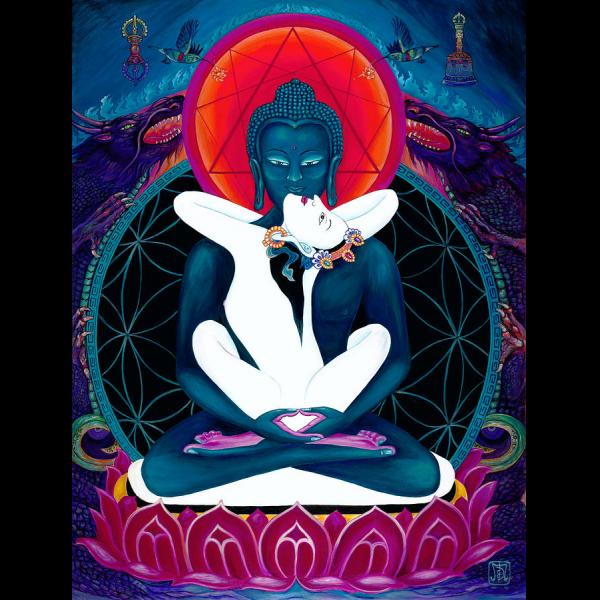
Kali standing on Shiva symbolizes the blessings she bestows upon her devotees. Shiva represents the passive potential of creation—the unchanging Purusha or “man,” while Kali represents the active Prakriti or nature. Together, they symbolize the ultimate reality.
Another interpretation of Kali standing on Shiva or engaging in sexual union with him in an inverted position is that it symbolizes the involution of meditation, the means by which a person “recreates” the universe to experience the blissful union of Shiva and Shakti.
The overwhelming presence of death imagery in Kali’s descriptions can also be understood as a symbol of her transformative nature. She strips away the superficial to reveal life’s essence.
New to attunements? Start here
Goddess Mahakali spiritual Courses, Empowerments/Attunements